By Karenna Johnson
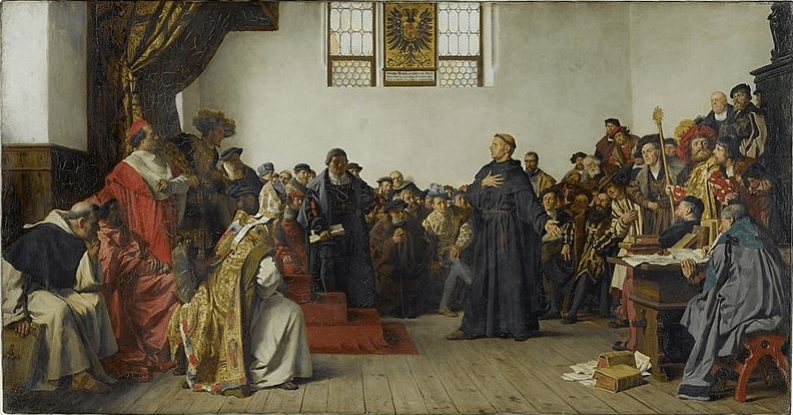
(Essay written by my AP European history course responding to the prompt, evaluate to what extend the changes of the past 600 years have been healthy or unhealthy for Europe.) Feature image of Luther before the Diet of Worms by Anton von Werner.
Over the last 600 years, individualistic and scientific cultures displaced the old, medieval systems and propelled Europe’s modern progress. The 1400s Middle Ages culture was structured and hierarchies were unchanging. The 1400s economic systems were dominated by feudalism, and governments by monarchs who were often propped up by the Catholic church. These social and political norms contrast today’s dynamic and individualist culture. In modern Europe, personal expression is everywhere, capitalism and the free market are the standard economic system, and governments have constitutions to protect the rights of all — not just the elite of society. The Protestant Reformation led by Martin Luther marked a pivotal transition in European and world history, setting the stage for today’s individualist societies.
The Reformation’s original purpose may have been to change the religious sphere of Europe, but Luther’s protest changed the whole landscape of modern thinking as well. Ideas like individualism and personal beliefs were simply impossible without the Protestant Reformation. Many of these new reforms were unpopular to begin with and sparked opposition through violence and protest. The Reformation led to a loss of unity and the beginning of major widespread intolerance experienced throughout these cultural shifts. These were uncomfortable changes for Europeans. However, the freedoms and the progress brought about after the Reformation — including the elevation of “common people” — improved lives for virtually all Europeans. Therefore the changes throughout the past 600 years, brought about by the massive transformation via the Protestant Reformation, has overall been a net positive for European and world civilization.
First, the Protestant Reformation transformed a religion that had become corrupt. As Protestants split from the Catholic Church, tensions between the two groups ran high. These tensions marked the beginning of a long history of religious intolerance that later led into other types of partisan views. Directly following the Reformation, the 30 Years’ War broke out. Although this war had both religious and political agendas, religious decimation was at the root. The 30 Years’ War was one of a long chain of other religious conflicts. For example the French and British civil wars. All of these wars were fought as a byproduct of the Reformation and the disconnect between religious groups.
The loss of unity in Europe due in part to the fracturing religion and intellectual ideas proved to be unhealthy for Europe. These effects were felt for hundreds of years. In 1897, Emile Durkheim published a book titled Suicide. In the book, Durkheim laid out his theories for the growing suicide rates and rapid urbanization. Put simply he wrote that individualism, excessive hope and freedom, and atheism were the key reasons for the growing rate of suicide. These ideas were especially common in the Industrial Revolution, but individualism, atheism and the others can be traced back to Luther. In the Reformation religious freedom opened a new door to intellectual freedoms not heard of before, in this new found freedom indivalism started to take root. The Protestant Reformation was the beginning of modern individualism, Luther was an advocate for a personal relationship with God. Ironically, not only did the Reformation lay the foundations for new branches of Christianty but also for the secularization of Europe. Within the new freedom of religion, some Europeans chose secularism as their preferred “faith.” The Industrial Revolution also led to the loss of the importance of family, before families worked in community with one another, however after industrialization the strength of family bonds weakened. The Protestant Reformation had a similar effect on cultural bonds, the loss of a common religion led to the loss of a larger community. Durkheim reflects on the growing atheism population in industrialized nations, the spread of individualism, and the effects of these two ideas when put together. Durkheim concludes that atheism and the loss of purpose religion gives and the increasing pressures of indivalist capitalism on Europeans led to the death of so many of them. The Prostant Reformation saw the beginning of intolerance to religious or intellectual ideas, it was also the spark of the new trend of religious violence due to the intolerance. Later these ideas would extend to social and political movements. Also the loss of community, and the growing emphasis on individualism led to some unhealthy mindsets throughout European history.
While it is clear some effects of the Reformation were negative, and the onset of individualism had negative ramifications, overall the freedom of choice was a healthy development. The Reformation pushed forward religious and intellectual diversity, the switch between a strict and unbending thought system to one that valued personal exploration of issues held to a healthy change for European thinking. The Reformation in this way set the stage for the Enlightenment. Impossible without the changes brought by Luther, the Enlightenment changed European minds to reason and logic focused. Hand and hand with the Scientific Revolution, the Enlightenment unlocked critical thinking in all areas of life. The progress brought by these events led to modern science, mathematics, economics and governments. Without this progress it is impossible to say where western society would be today.
Another positive change was the elevation of the common man. One of Luther’s core ideas was “priesthood of all believers” which emphasized how one’s relationship with God was a personal, direct connection, and not accessed through a priest. This idea was radical but as the Bible was translated into German and the printing press allowed access to the newly translated texts, common people now had access to empowering sacred texts that were previously unavailable. Similar to Luther’s elevation of the “common man”, Renaissance thinkers believed in humanism. Humanists believed there was potential in all people that merely needs to be cultivated. Although the Renaissance preached humanism over Luther’s Christianity, it was the Protestant Reformation that brought forth the opportunity to emphasize the importance of the common people. Effects of this change range from the san-culottes of the French Revolution to Marx and his the Communist Manifesto. It is difficult to overestimate the significance that the Protestant Reformation’s emphasis on regular people had on European society, thought, and culture — and ultimately on history.
Lastly, the Protestant Reformation changed the whole economic system of Europe. In The Protestant Work Ethic and the Spirit of Capitalism, Max Weber writes about the connection between the protestant lifestyle and the onset of capitalism. The “protestant work ethic” is clearly linked to the work of Luther and the Reformation itself. Great Britain was the first nation to industrialize, for reasons such as location and natural resources. However, it is also possible to connect this rapid industrialization and economic growth, at least in part, to the “protestant work ethic.” After Great Britain, the Netherlands and other western European countries also adopted the Industrial Revolution. Coincidentally, these countries all also possessed large Protestant populations. In 1776, Adam Smith published Wealth of Nations, a work that introduced the free market. Smith’s work is baked into the American constitution and also into much of western Europe’s economic systems; it changed the whole scope of western economics. Ideas of the free market took away old ideas like mercantilism and the guild system and replaced them with capitalism. Capitalism itself is a highly debated whether or not it has been a healthy development. Capitalism can lead to some negative events like the scramble to colonize Africa, however the competition of free markets allows for the creation of more successful economic systems. The Protestant Reformation built the groundwork for mindsets that created the free market. Free trade and markets have pushed culture toward what it values today.
When Luther nailed his 95 Theses to the door of a church in Wittenberg in 1517, he could not have known just how influential his actions would become. All developments after 1517 seem simply impossible without the influence of the Reformation. Luther ushered in new ideas like individualism and “priesthood of all believers.” Individualism is a cornerstone of current cultural movements.While the loss of community has been negative for Europeans, the freedoms and progress individualism has sparked proves how deeply important and essential it is. Although religious intolerance ran deep in society before and after the Reformation, efforts to elevate the common people have proved to be more valuable and more positive than negative. Luther freed the mind and market, leading to progress that has taken us to a much healthier Europe and a better world overall.
 karennajohnson.com
Leave a comment