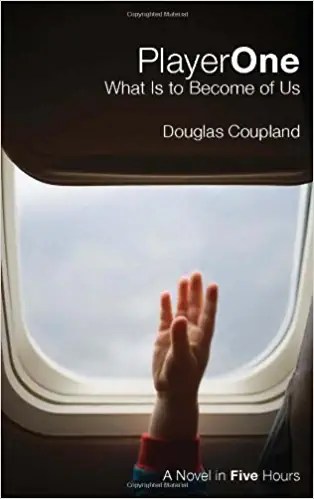

Review: Player One: What Is to Become of Us
By Karenna Johnson
Douglas Coupland’s PlayerOne, What is to become of us? is fantastic. Coupland presented his Massey Lectures (a five part lecture series given by famous Canadian authors/thinkers) in this 2010 novel. Coupland calls this book “a novel in five hours”, because in book time the story plays out in five hours so readers get to watch the novel happen “real time”.
The story begins by introducing the five main characters, Karen, Rick, Luke, Rachel and Player One, who all end up in an airport cocktail bar. Karen is an almost 40, single mom who flies to meet an online date. Rick is the airport bartender, who loves Leslie Fremont, a TV motivational speaker. Luke is a fallen-out-of-faith pastor who steals all the money from the church, runs away and ends up in the airport bar. Rachel is a lab mice researcher, whose parents think she’s too much like a robot, so she goes to the airport bar to become human. And lastly, Player One is a mysterious commentator, who later is revealed to readers.
At the bar, the characters spend five hours together discussing, among other existential topics, their reaction to an ongoing global oil crisis. Through this crisis Coupland shows what the characters value as evidenced by their reactions.
Throughout Player One Copeland explores what it means to be human – or “what is to become of us,” as Coupland puts it. Each of Coupland’s characters show humanity in a new light. Each character has sympathetic faults. Although each of his characters seem to be questioning the same issues, in a beautifully poetic way Coupland uses each character’s voice to show the beauty of the human condition.
In his novel, Coupland specifically explores the human perception of time. (It is called “a novel in five hours” for a reason!) Time plays a central role in both character development but also in the themes explored. Coupland almost uses time to make readers feel claustrophobic and hopeless. He writes:
Our curse as humans is that we are trapped in time; our curse is that we are forced to interpret life as a sequence of events – a story – and when we can’t figure out what our particular story is, we feel lost somehow.
Coupland writes that time is a constraint, it limits our human perception, because we can only interpret our lives from “beginning to end” we somehow lose something. He also argues that our linear time perception creates feelings of “lostness” that can make us feel a lack of purpose.
We live linearly. Whether we want to or not we cannot go either back in time or forward in time. This is just the basic human reality. Because of our linear nature, we perceive time as “a story”. (Stories are a common theme throughout Coupland’s works, especially in Generation X.) Coupland seems to say realizing our story’s true meaning and purpose is our ultimate calling. When understanding and living our lives becomes confusing, we get lost. Each one of Player One’s characters is at a turning point in their lives where the vitality of their story is questioned.
Coupland again shows this idea to readers:
By the age of twenty, you know you’re not going to be a rock star. By twenty-five, you know you’re not going to be a dentist or any kind of professional. And by thirty, darkness starts moving in- you wonder if you’re ever going to be fulfilled, let alone wealthy and successful. By thirty-five, you know, basically, what you’re going to be doing for the rest of your life, and you become resigned to your fate…
As humans age, the grip and pressure of time gets tighter, until all the sudden at thirty-five a confining passivity consumes your story. Coupland uses this example of one of his character’s inner dialogue to illustrate the claustrophobia he expresses throughout the novel. However, here Coupland adds, is how most people “resign to their fate.” We get so busy trying to do all these things, but we forget to make meaning in what we already have and what we already are. Coupland shows us how we get lost, stuck in linear time. We hope and dream but ultimately we must face our fate: resign to it or learn to harness it.
But this isn’t how Coupland ends his novel. He writes, “Life need not be a story, but it does need to be an adventure”. We do not need to resign to our fate or live in the “lost”, ever-racing time. We need to reach out and hold tight to what will give us life.
The beauty of Coupland is that he can use beautifully normal characters, engaging plots to make more and more of the human experience a little more tangible, a little easier to understand. Coupland doesn’t play into dramatics, but he uses beautifully simple ways to express both realism and hope.
Lastly, Coupland challenges us all to just take five hours to sit and wonder: What will become of us?
Cover Image via Coupland.com
 karennajohnson.com
Leave a comment