REVIEW: The ballad of 18-“When We Were Young”
By Karenna Johnson
“When We Were Young”- 2018 Tencent Chinese Drama
9.75/10
I love this drama. Everyone that worked on this project did such an amazing job. The acting, the plot, the set design and even down to the cinematography is exceptional. The drama perfectly mixes humor and reality to create a very affecting storyline. Highly, highly recommend.

Number of episodes: 24
Aired: Nov 22, 2018 – Dec 28, 2018
Leading Actors:
- Yang Xi: Wang Peng
- Hua Biao: Hou Ming Hao
- Li Yu: Zhang Yao
- Yang Xiao He Mei: Pan Mei Ye
- Si Tu Er Tiao: Li Ming De
The Ballad of 18:
“When We Were Young” is an exploration of being 18 years old in 1996 China. As an American who is not yet 18, does not live in China and also has not experienced the 90s, it seems like this Chinese drama would have very little commonality to my life and impact overall. However, the writers, director, actors and others who worked on this project did an unparalleled job at making this drama deeply meaningful.
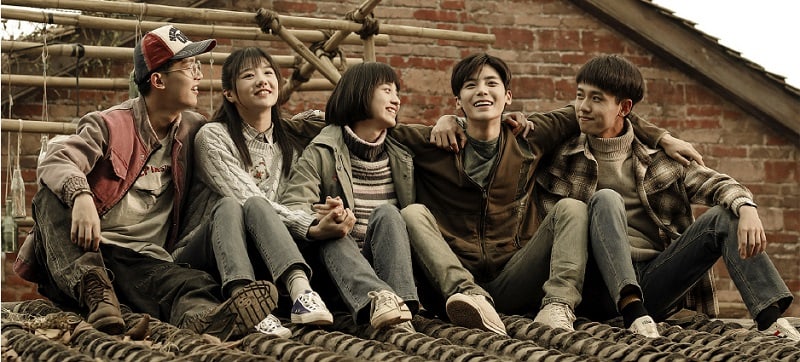
“When We Were Young” is deceptively shown as a lighthearted comedy centric drama, but in reality the lightheartedness masks the struggles that the show’s creators address throughout the development of the characters. The plot follows five central characters, who each face their own struggle that helps define them, the female lead, Yang Xi; the male lead, Hua Biao; the second male lead, Li Yu; the supporting female character, Yang Xiao He Mei; and lastly the supporting male character, Si Tu Er Tiao. Together these five characters define the drama.
I could write about so many different threads that weave together the beautiful central purpose of the drama, like relationships with parents, the stress of education and school, divorce, technology in the 90s and so on. But this drama revolves around each character facing their own struggle and friendship as these struggles arise. “When We Were Young”, shows the ultimate value of meaningful friendships but also the uniqueness of each individual person that makes each connection meaningful. The reliance of friendship is shown as a theme as characters struggle though getting older and the increasing responsibility that getting older entails.
The value of meaningful friendships is mostly clearly shown in the female lead Yang Xi’s personality. Yang Xi is introduced to the audience as a very carefree character, who is not very aware of the feelings of those around her. However as the drama continues Yang Xi’s intricate ability to be intune with what her friends are feeling, illustrates friendships on a different level. Most clearly shown in a section where Li Yu isolates himself in response to his estranged mother remarrying. Yang Xi’s ability to first sympathize with Li Yu and then to offer Li Yu a way out of his isolation through a deep understanding of his character and a deep friendship with him, ultimately leads Li Yu letting go of his idea of his mother that kept him isolated.
“When We Were Young” offers a pure, untainted, view of friendship that I think is lost in a lot of American TV. (This is something I really appreciate about Chinese TV.) The purity but also the faults of these characters help to illustrate friendship on the deepest level.
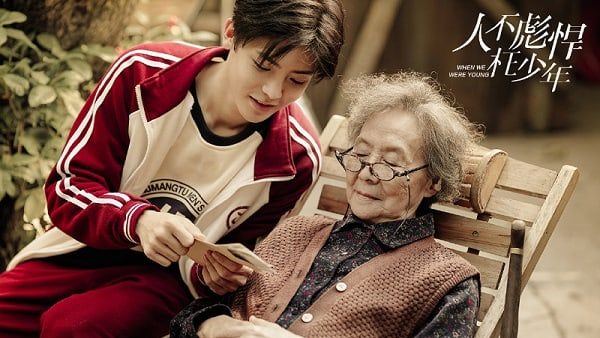
The other theme of struggle and responsibility is exemplified in Hua Biao’s character. At the beginning of the drama, Hua Biao was kicked out of his old high school for starting a fire during a chemistry experiment, and ends up at Yu Cai high school with the rest of the characters. Hua Biao’s biggest struggle throughout the drama is his grandma’s increasingly severe Alzheimer’s disease. Hua Biao’s parents died when he was 3 months old, so he grew up under the care of his grandma. Throughout the drama, Hua Biao struggles with taking responsibility for both the safety of his grandma but also all the finances of his family. Audiences also watch the devastating decline of Hua Biao’s grandma’s memory–to the point where she doesn’t even remember her grandson. At the beginning, audiences only see the youthful and happy Hua Biao but as the plot progresses Hua Biao is thrown into making adult sacrifices. Although Hua Biao faces extreme challenges throughout the drama, he still maintains happiness, which is his defining quality.
Both friendship and the struggle of growing up are common themes in dramas set during high school (both American and Chinese), however the writers of “When We Were Young” did something truly special with this drama. The authenticity, purity, and reality of this drama creates a deeply touching exploration of growing up.

I love to watch Chinese dramas, TV shows, and movies. I want to use my love for Chinese culture and people to help bridge the Sino-American gap, I think this starts with a willingness to understanding one another. So I hope through these reviews I can better understand Chinese culture and people and share my insights with my readers.
READ MORE:
 karennajohnson.com
Leave a comment