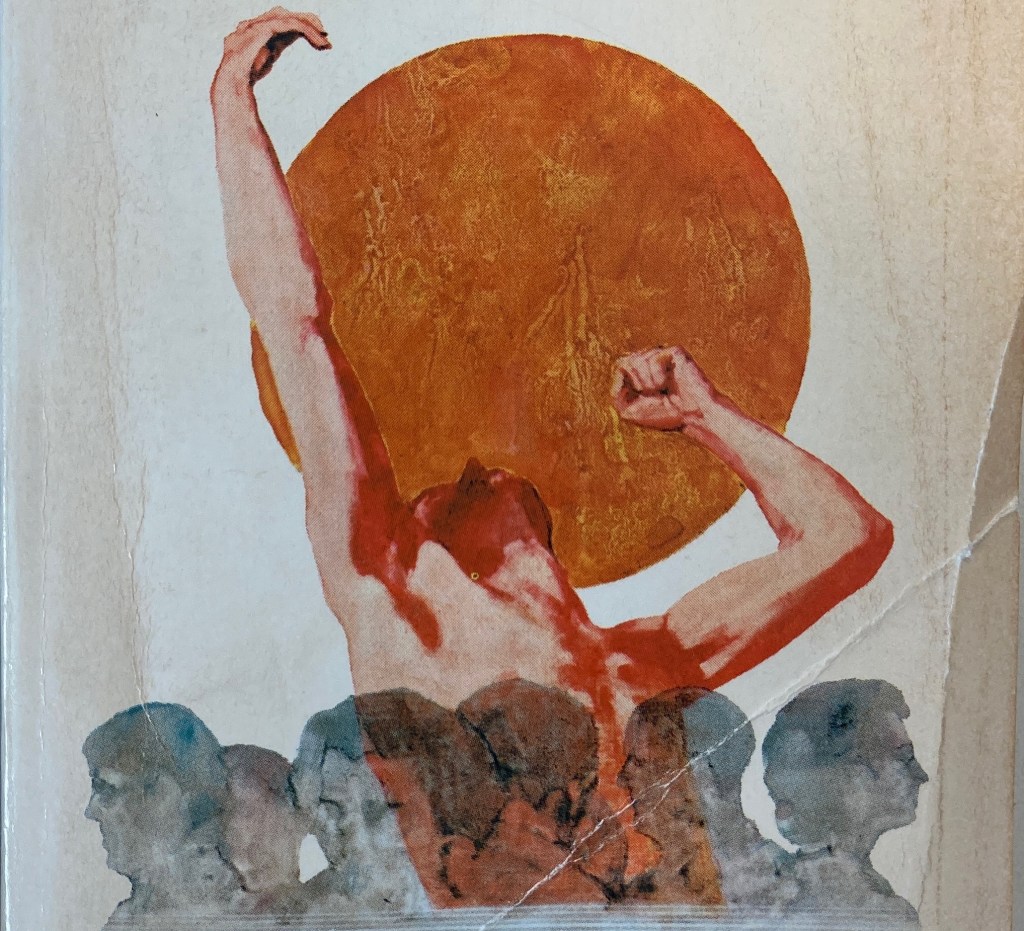
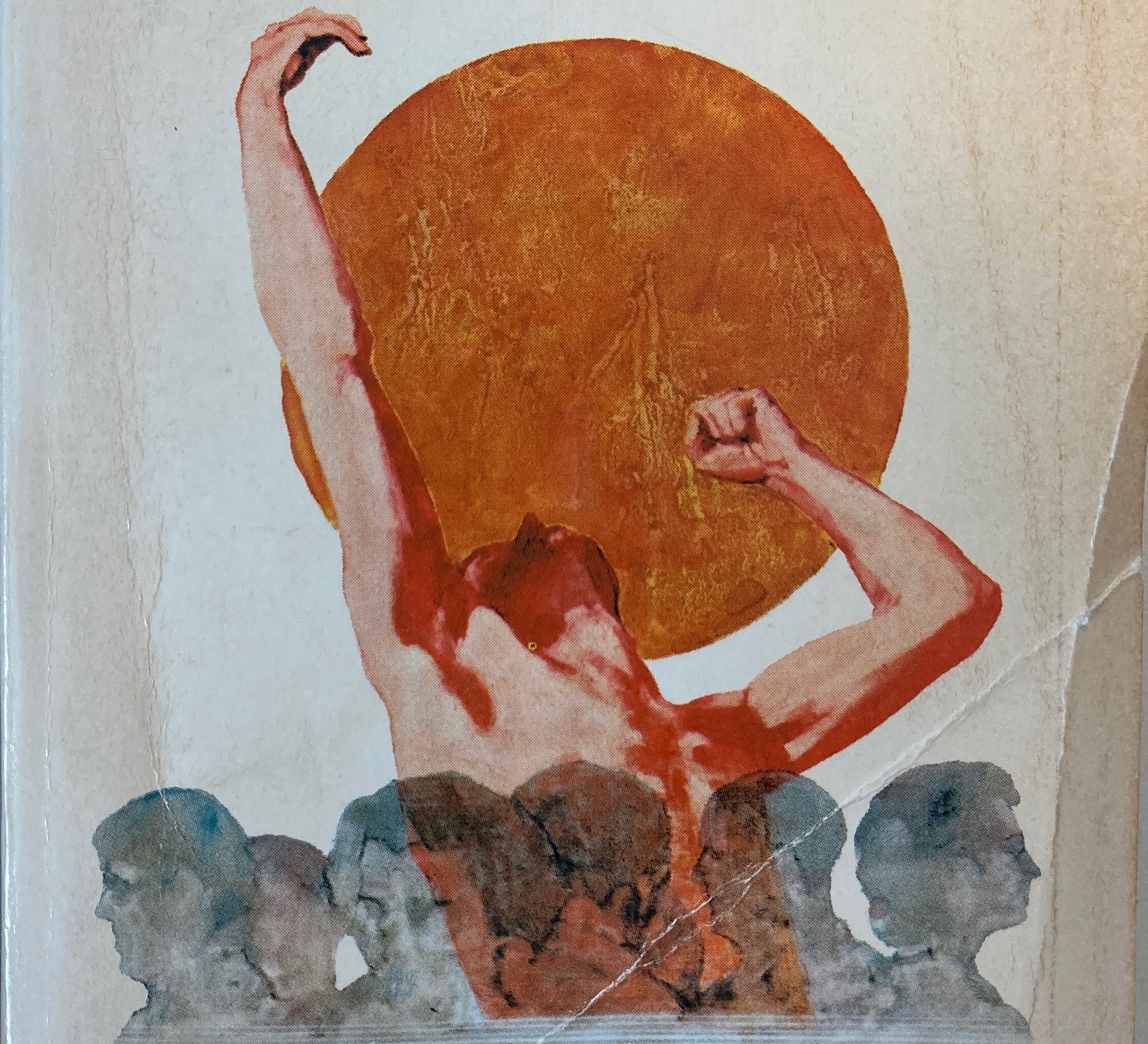
ANTHEM, “I” not “we”. A look into Ayn Rand’s chant for EGO
By Karenna Johnson
Anthem was first published in the United Kingdom in 1938, later Rand edited it for American publication in 1946. This is a troubling book, by a troubling author.
Ayn Rand born in Russia, raised in the United States, rose to fame after the publishing of her 1943 novel, The Fountainhead. Rand is most famous for her concept of objectivism. Rand’s view of objectivism took off in 40s in the United States. The 4 pillars of Rand’s theory are objective reality, absolute reason, individualism, and laissez-faire capitalism. You cannot read a Rand novel without interacting with her hard lead beliefs.
Anthem (1946), one of Rand’s novellas, explores themes of freedom, oppression, and especially ego. (These themes are not unique for the works of Rand.) Set in a dystopian future, the beginning of the novella explores a strict government structure. It reminded me of the classic dystopian books like 1984, Brave New World, but it reminded me most of a children’s novel called The Giver by Lois Lowry.
Rand introduces the protagonist to readers by, “Our name is Equality 7-2521” (13). Rand writes the majority of this novel uses only “we, our, they”, no singular possessive pronouns are used. Adjusting to reading “we” instead of “I” took me a second, however the use of the word “we” is central to Rand’s purpose in the novella.
Rand is a great world builder. Her dystopian future seems eerily possible in some fronts. The world Rand creates after “The Great Rebirth” and introduced to readers by Equality 7-2521, has strict rules and roles. Initially, Rand takes out the institution of family, after “The Great Rebirth”, children are born to the “Home of Infants” then they go to the “Home of Students”. No type of familial bond is formed between any characters, and they seem to have no concept of family. (I believe this is an interesting choice on Rand’s part. I would think that Rand herself would not fully like the concept of family, because family within itself limits individual freedoms. Family as an institution is a mostly binding contract, where rights are given up for the betterment of everyone. Rand fundamentally argues against giving up rights in Anthem.)
Equality 7-2521 in describing the world the narrative recites a chant they were given in the Home of Students:
“We are nothing. Mankind is all. By the grace of our brothers we are allowed our lives. We exist through, by and for our brothers who are the State. Amen.” (16)
Rand reinforced the strict, unbending structures of her created world, through language, characters, and the narrator’s own wish to fit in within the society, but also rebelling.
Equality 7-2521’s rebellion begins in his upset after receiving his job from the Council of Vocations. He wished to be a member of the Home of Scholars, stating “we wished to be a scholar” (21). However, Equality 7-2521 is to be a street sweeper. Despite his disappointment, Equality 7-2521 like the rest says, “The will of our brothers be done” (23).
Shortly after beginning his job as a street sweeper he finds a tunnel “left from the Unmentionable Times”. In Equality 7-2521’s first act of rebellion he does not report it to the City Council. Throughout the majority middle section, Equality 7-2521 sneaks away and performs experiments in his tunnel. Where he (re)discovers electricity. His first thought upon his discovery, he thinks “we can give our brothers a new light” (64). Equality 7-2521 is torn between the brotherhood (which he desperately wants to belong to) and his curiosity (which goes against all rules).
However, Equality 7-2521 is caught one day where he goes to the Palace of Corrective Detention. Where “we” undergoes torture, are later escapes. He writes:
‘It was easy to escape from the Palace of Corrective Detention. The locks are old on the doors and there are no guards about… for men have never defied the Councils so far as to escape from whatever place they were ordered to be” (73)
After his escape he goes to the Home of Scholars and shows them his creation, “the light”. He is rejected, with one scholar saying “What is not thought by all men cannot be true” (81). Thoroughly rejected, Equality 7-2521 runs into the Uncharted Forest. Where he begins his journey away from his wish to conform. After his first night in the forest he writes:
“We have not built this box for the good of our brothers. We built this box for its own sake” (85)
Equality 7-2521’s journey into the woods, marks the beginning of Rand’s radical ideological push. Throughout the novel, Rand shows that there is an Unspeakable Word,
“What–even if we have to burn for it like the Saint of Pyre– What is the Unspeakable Word” (53)
Later again in the forest, Equality 7-2521 says, “and we felt torn, torn for some word we could not find”.
Eventually, Equality 7-2521 and his companion he calls the Golden One, find an abandoned house. Where they find books. (“May knowledge come to us!” (107)) The next chapter opens with:
“I am. I think. I will”
Rand begins to use the Unspeakable Word, and with it starts to push her ideals more harshly onto readers. “I” now begins to see the world around him differently, he starts to question the warrant for life. He writes, “I wished to know the meaning of things. I am the meaning” (108). This sentence marks the shift to Rand’s belief in the individual.
Rand turns the ending into a selfish glorification of man. Equality 7-2521, loses all feeling of relatability on being torn between curiosity and belonging. To an overly indulged character. “I” now believes in the tranny of “we”, calling it evil. And he writes in defense of his new found self-glorification writes (113),
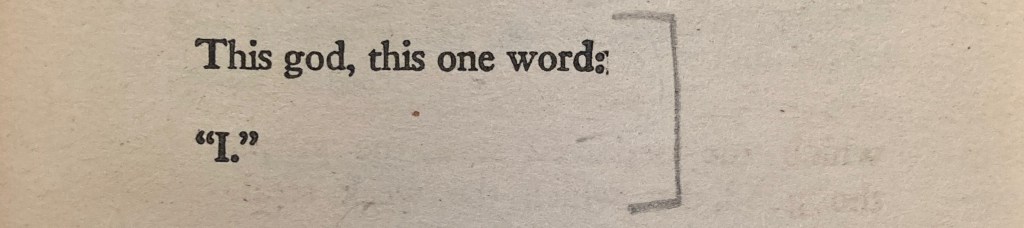
Rand’s one belief in the “god” like figure of man, really shows brightly in the last chapters of Anthem. Submitting to authorities unquestioningly is a vice, too much self-idolization is also a vice.
Later, Equality 7-2521 changed his name to Prometheus. The Greek god who brings fire to mankind to save them. This new “Prometheus” has similar goals in mind. He wants to be the liberator of those who are oppressed. Saying, “My future is clear before me. The Saint of the pyre has seen the future when he chose me as his heir” (116) Prometheus glorifies his views and actions too much. Although those living in the dystopian world, Equality 7-2521 was also from. The new character of Prometheus only wants to save them from their oppression for his own glory’s sake (this is not directly from the book, however this was the feeling I was getting from reading his rants).
Yes- some of what Prometheus says is correct. Like the slow fall of mankind into submission, “But I still wonder how it was possible, in this graceless years of transition, long ago, that men did not see whether they were going, and went on, in blindness and cowardice, to their fate” (120). Rand gives us a good warning to be free from blindness and fight against downturns in society’s trajectory. We must stay awake, so as to not fall into a nightmare. Rand also writes, “perhaps they cried out in protest and in warning. But men paid no heed to their warning” (121). Rand here also gives good advice to our society today, we must not silence warning voices, rather we need to listen. We cannot fall into an oppressive society that does not value human individualism. However, we must not do this for our own glory, rather WE must love our neighbors and do it for the sake of them.
Lasty, Rand and Prometheus finish the novel with their sacred world:

END OF STORY
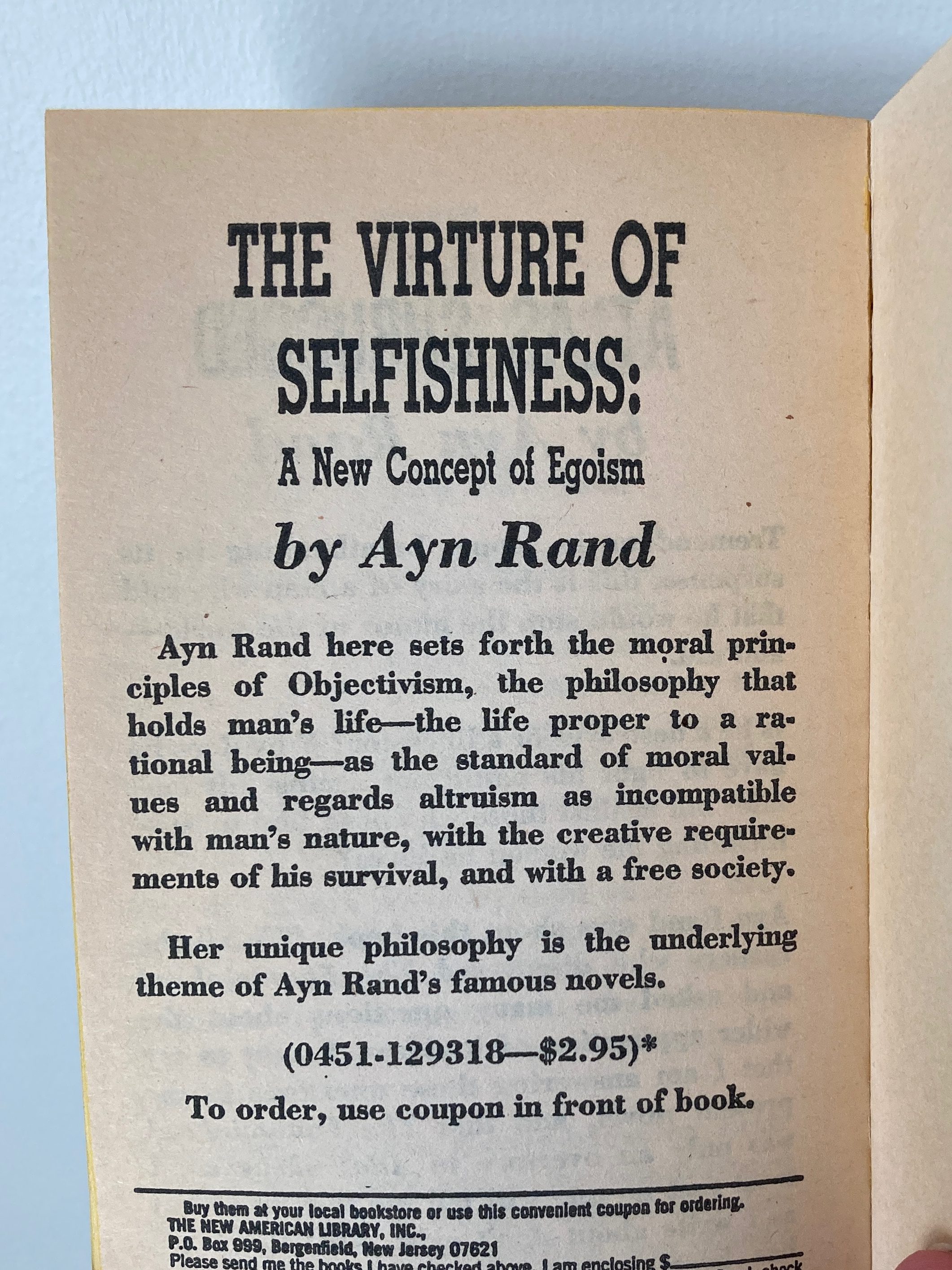
(I find fault in this as well, EGO is not a positive thing when unchecked. However, we must be humble to help our neighbors. The last page of my copy of this novel has printed:
THE VIRTUE OF SELFISHNESS
A new concept of Egoism
By Ayn Rand
I think I must leave it at this: Do nothing from selfish ambition or conceit, but in humility count others more significant than yourselves. Philippians 2:3 )
 karennajohnson.com
Leave a comment